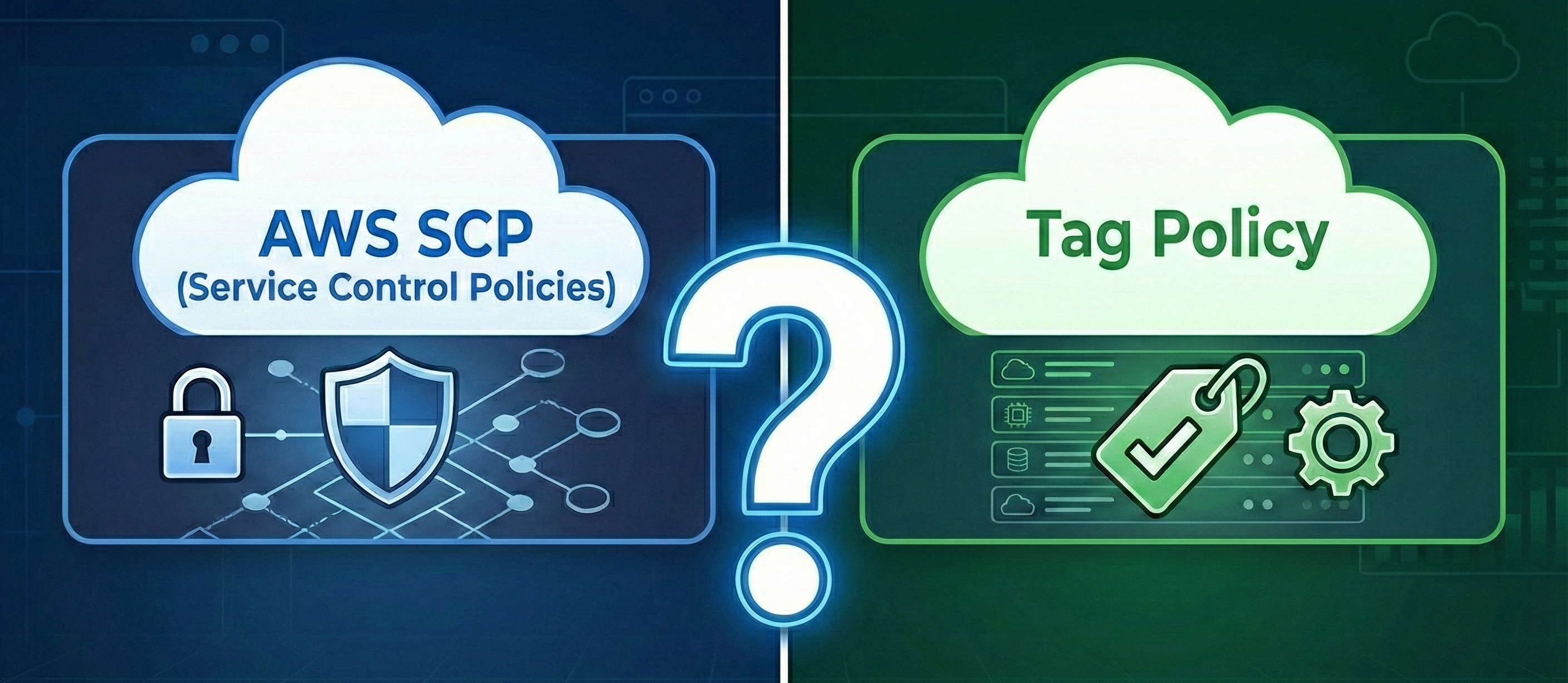
The Tagging Governance Gap
In multi-account AWS environments, inconsistent tagging destroys cost allocation accuracy, security automation, and compliance reporting. Manual tagging approaches fail at scale-engineers forget tags, automation tools bypass standards, and shadow IT creates untagged resources. AWS Organizations provides two policy mechanisms, but misapplying them creates governance blind spots.
SCPs operate as identity-based guardrails, evaluating API requests before resource creation. They enforce presence but cannot validate value formats or case consistency. Tag Policies operate as resource-based validators, checking compliance after creation and supporting complex validation rules, but cannot prevent resource launch when enforcement is disabled.
Core Technical Distinctions
Service Control Policies (SCPs)
SCPs are explicit-deny policies attached to OUs or accounts that filter API calls made by IAM principals. For tagging, they use
aws:RequestTag and ec2:ResourceTag condition keys to block resource creation when required tags are absent.
Key Characteristics:
- Evaluation Point: Pre-creation API request filtering
- Scope: All AWS services and actions (broad coverage)
- Enforcement: Binary-denies or allows; no partial compliance
- Latency: On error, it takes time to understand why did we get an error (need to evaluate SCP's and understand which one blocked the request).
- Limitations: 5 SCPs per OU/account, 5,120-byte size limit
Example SCP Blocking Untagged EC2 Instances:
{
    "Version": "2012-10-17",
    "Statement": [
        {
            "Sid": "DenyUntaggedEC2",
            "Effect": "Deny",
            "Action": "ec2:RunInstances",
            "Resource": "arn:aws:ec2:*:*:instance/*",
            "Condition": {
                "Null": {
                    "ec2:ResourceTag/Environment": "true"
                }
            }
        }
    ]
}
Tag Policies
Tag Policies are JSON documents defining tag schema rules, attached to OUs or accounts. They validate tag keys, values, case treatment, and can enforce compliance on supported resource types.
Key Characteristics:
- Evaluation Point: Post-creation validation and compliance reporting
- Scope: 50+ AWS services with enforced_for support (limited coverage)
- Enforcement: Optional-can operate in report-only or enforcement mode
- Latency: The time it takes to remediate
- Capabilities: Value pattern matching, case enforcement, tag key standardization
Example Tag Policy Enforcing CostCenter Values:
{
    "tags": {
        "CostCenter": {
            "tag_key": {
                "@@assign": "CostCenter"
            },
            "tag_value": {
                "@@assign": ["HR", "Legal", "Engineering"]
            },
            "enforced_for": {
                "@@assign": ["ec2:instance", "rds:db"]
            }
        }
    }
}
Key Characteristics Comparison
Here's a side-by-side comparison of the key characteristics between SCPs and Tag Policies:
| Characteristic | Service Control Policies (SCPs) | Tag Policies |
|---|---|---|
| Evaluation Point | Pre-creation API request filtering | Post-creation validation and compliance reporting |
| Scope | All AWS services and actions (broad coverage) | 50+ AWS services with enforced_for support (limited coverage) |
| Enforcement | Binary-denies or allows; no partial compliance | Optional-can operate in report-only or enforcement mode |
| Latency Impact | On error, requires time to evaluate which SCP blocked the request | Time it takes to remediate non-compliant resources |
| Limitations | 5 SCPs per OU/account, 5,120-byte size limit | Limited to services that support enforced_for; sub-resource enforcement gaps |
| Primary Use Case | Prevent resource launch without mandatory tags (hard guardrails) | Ensure tag consistency and value standardization (soft governance) |
When to Use Each Approach
So which one to use when? Let's take a look at some scenarios:
| Scenario | Primary Requirement | Recommended Approach | Rationale |
|---|---|---|---|
| 1. Preventing Production Resources in Dev Accounts | Block EC2/RDS launch without Environment=prod in production OUs | SCP with StringNotEquals condition | Immediate prevention required; SCPs evaluate before resource creation |
| 2. Standardizing Cost Allocation Tags | Ensure all resources have CostCenter with approved values (HR, Legal) | Tag Policy with enforcement | Value validation needed; supports 50+ resource types; non-blocking |
| 3. Enforcing Data Classification Tags | Require DataClassification tag on S3 buckets, DynamoDB tables | SCP + Tag Policy hybrid | SCP prevents launch; Tag Policy validates value format (Public, Confidential, Restricted) |
| 4. Blocking Public S3 Buckets | Deny s3:PutBucketPolicy if bucket has PublicAccess=true tag | SCP with tag-based conditions | Real-time prevention critical; SCPs can evaluate resource tags during policy changes |
| 5. Validating Tag Case Consistency | Force Environment (not environment or ENVIRONMENT) | Tag Policy with case enforcement | Tag Policies uniquely support case-sensitive key validation |
| 6. Preventing Resource Launch Without Owner Tag | Block all resource creation missing Owner tag | SCP with Null condition | Broad coverage across services; SCPs work on all Create APIs |
| 7. Enforcing Department-Specific Tag Schemas | Finance OU requires BudgetCode; Engineering OU requires ProjectID | Tag Policy per OU | Tag Policies support OU-specific schemas; SCPs would require separate policies |
| 8. Auditing Existing Resource Compliance | Identify resources violating tag standards without blocking creation | Tag Policy in report-only mode | Zero operational impact; generates compliance reports via Resource Groups |
Key Insight
Tag policies and SCPs are complementary to each other-not interchangeable.
The right way to implement tagging in your AWS Environment is to use them together in a layered approach:
Layered Policy Approach
Root Level:
- Mandatory Tags SCP: Block untagged resource creation for critical tags only (Environment, DataClassification)
OU Level (Tag Policies):
- Development OU: Enforce Environment=dev, CostCenter, ProjectID with value validation
- Production OU: Enforce Environment=prod, DataClassification, Compliance with case sensitivity
Implementation phases:
- Phase 1: Deploy Tag Policies in report-only mode for 30 days to baseline compliance
- Phase 2: Enable enforcement on Tag Policies for supported services (EC2, RDS, S3)
- Phase 3: Deploy SCPs for critical tags that cannot be enforced via Tag Policies (EMR, Lambda, cross-service)
- Phase 4: Monitor CloudTrail ServiceEventDenied events to tune false positives
- Phase 5: Implement automated remediation via AWS Config rules for existing non-compliant resources
What to Avoid?
Over-Specific Tag Enforcement
SCPs cannot validate regex patterns or enumerated values. Attempting to enforce CostCenter format via SCP requires multiple StringNotLike conditions, hitting the 5,120-byte limit quickly.
Blocking Tag Deletion with SCPs
While possible, using SCPs to prevent ec2:DeleteTags creates operational lock-in. Tag Policies' native tag retention
capabilities are more maintainable.
Service-Specific SCPs for Tagging
Creating separate SCPs per service wastes quota. Combine related services into single SCP using Resource element wildcards where possible.
Tag Policy Limitations
- Enforcement Gaps: Tag Policies validate tags on the master resource, not auto-created sub-resources. EMR clusters launching EC2 instances propagate tags inconsistently-SCPs are required for sub-resource enforcement.
- Partial Service Coverage: Only 50+ services support enforced_for. Services like Lambda, EMR, and many container services require SCP fallback which might be disruptive and not user friendly.
Conclusion
SCPs and Tag Policies are not interchangeable-they are complementary governance layers. SCPs provide hard guardrails preventing resource launch without mandatory tags, essential for security and compliance boundaries. Tag Policies provide soft governance ensuring tag consistency and value standardization, critical for cost allocation and automation.
The critical insight: Use SCPs to enforce tag existence on critical resources (production workloads, data stores, security services) where launch prevention is non-negotiable. Use Tag Policies to enforce tag quality (value formats, case sensitivity, schema compliance) across all resources where reporting and gradual remediation suffice.
Your tagging strategy should be layered, not monolithic. Start with Tag Policies in audit mode, add SCPs for critical tags, and refine based on real-world developer feedback. This approach prevents governance from becoming a deployment bottleneck while maintaining security and cost management integrity.
Ready to Simplify Your Tagging Strategy?
TagOps can help you implement and maintain a comprehensive tagging strategy across all your AWS accounts without the complexity of managing SCPs and Tag Policies manually.
Get TagOps on AWS Marketplace